Aurora sits on glacial outwash and alluvial deposits along the Fox River. We often see contractors surprised when clean sands at 6 feet depth fail to meet 70% relative density. That gap drives settlement claims and foundation rework. Vibrocompaction design closes it. By specifying probe spacing, vibration frequency, and lift thickness, our team turns loose granular soils into competent bearing strata. The work references ASTM D6066 and local borehole logs—usually SPT N-values under 12 in the pre-treatment profile. In east-side industrial parks near the BNSF rail corridor, fill thickness can exceed 15 feet, which means the compaction grid has to account for lateral confinement loss near buried utilities. Pairing the design with SPT drilling confirms post-treatment improvement, and for silty lenses we sometimes cross-check with CPT testing to catch thin low-density seams that vibroflots alone miss.
A well-designed vibrocompaction grid targets the weak seams—not the average—so post-treatment settlement stays below half an inch.
Technical details of the service in Aurora Illinois
Working video
Local geotechnical conditions in Aurora Illinois
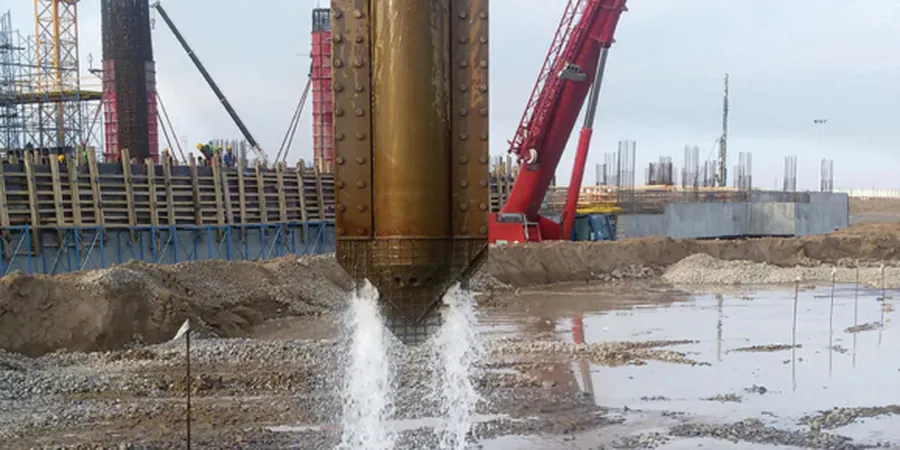
The vibroflot probe descends under its own weight plus vibration, displacing grains until they lock into a denser packing. In Aurora, the real risk is differential densification. A probe that encounters a gravel stringer at 14 feet can deflect off-vertical, leaving a shadow zone of loose soil directly adjacent to a dense column. That shadow zone becomes a settlement trigger under strip footings. Another risk surfaces when compaction-induced pore pressure builds in silty interbeds; if the dissipation window is too short, the next probe pass liquefies the surrounding soil instead of densifying it. Our designs schedule a minimum 48-hour rest period before verification testing and specify staged probe withdrawal rates—typically 12 to 18 inches per minute through the critical depth band. The goal is uniform density, not just an average N-value that looks good on a summary table.
Our services
Our vibrocompaction work in Aurora covers the full design-to-verification cycle. Each package is calibrated to the Fox River basin stratigraphy and the specific performance criteria of the project.
Vibrocompaction Design Package
Probe grid layout, depth-energy sequencing, water flush rates, and backfill specification for loose sands and granular fill. Includes pre- and post-treatment SPT/CPT verification locations keyed to existing borehole logs.
Liquefaction Mitigation Assessment
Post-compaction analysis using Seed-Idriss triggering curves and site-specific PGA from ASCE 7-22. Delivers a signed report showing factor of safety against liquefaction for the design earthquake.
Common questions
What does vibrocompaction design cost for a site in Aurora?
Design fees typically range from US$1,520 to US$5,640 depending on treated area and number of verification points. A half-acre site with 10 SPT verification tests falls near the lower end; multi-acre industrial parcels with CPT cross-checks and liquefaction analysis approach the upper bound.
How long does the design phase take before the vibroflot arrives on site?
Standard turnarounds are 7 to 10 business days after we receive existing geotechnical data. Expedited delivery is available for projects with imminent mobilization dates.
Can vibrocompaction handle silty sands common near the Fox River?
It works best with less than 12% fines. For silty zones, we adjust water flush, slow withdrawal rates, and sometimes specify a bottom-feed system. If fines exceed 15%, stone columns or compaction grouting may be a better fit.
What verification testing do you require after treatment?
We specify SPT or CPT at 24 to 72 hours post-treatment, typically at one test per 2,500 square feet. The acceptance criterion is a minimum relative density of 70% or an SPT N-value correction above 25 blows per foot.