Beneath Aurora IL, the glacial drift runs deep. We have encountered 40 to 60 feet of stiff silty clay over limestone bedrock across Kane County. That means shallow footings often hit bearing capacity limits fast. For the Paramount Theatre expansion, the structural loads demanded a deep foundation strategy. Pile foundation design in Aurora is not a copy-paste job. The water table sits high in pockets near the Fox River. Seasonal frost penetrates 42 inches here. Combine those factors and you need a pile system that resists settlement, frost heave, and lateral loads from seismic events. Our team integrates seismic refraction profiles to map bedrock depth before selecting pile type and length, and we lean on CPT soundings when continuous soil behavior data is required across a variable site.
In Aurora's glacial clays, skin friction often controls pile design more than end bearing on limestone.
Technical details of the service in Aurora Illinois
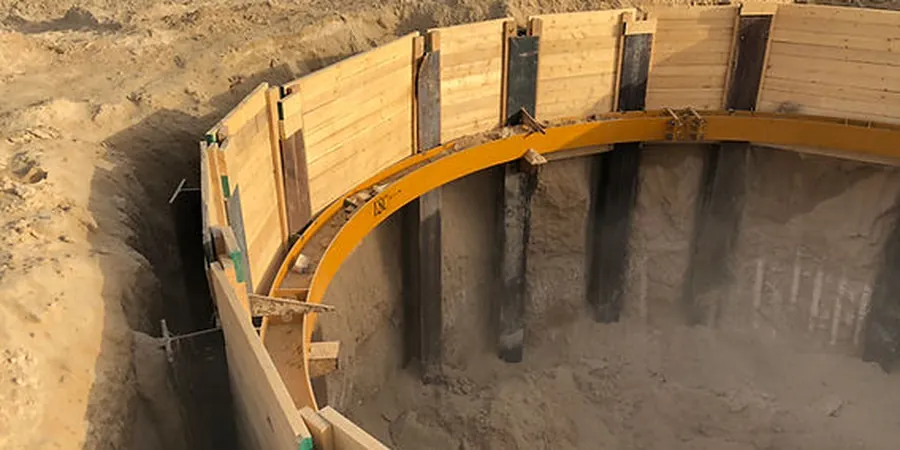
Local geotechnical conditions in Aurora Illinois
Aurora sits 676 feet above sea level, and the Fox River cuts right through the city center. Floodplain silts and loose alluvium near the water create a sharp contrast with the dense till on the uplands. We saw a warehouse project near Orchard Road where differential settlement cracked the slab within two years. The culprit? Variable soil stiffness across the pad. A uniform shallow foundation failed. A pile foundation design with a stiff pile cap would have bridged those soft lenses. Seismic demand under ASCE 7-22 adds another layer. Aurora is not on the San Andreas, but the New Madrid and Wabash Valley seismic zones still influence design spectra. Liquefaction potential in saturated river sands is real. Our liquefaction assessment evaluates that risk directly. We check cyclic stress ratios and specify pile lengths that reach below liquefiable layers.
Our services
Our pile foundation design services cover the full project cycle for Aurora developments, from feasibility to construction oversight.
Axial and Lateral Pile Capacity Analysis
We compute capacity using site-specific soil parameters and load test data. Our reports include LRFD resistance factors and settlement predictions for single piles and groups.
Pile Integrity and Construction Monitoring
We oversee installation, verify refusal criteria on bedrock, and perform PIT or crosshole sonic logging to confirm shaft integrity before structural concrete is placed.
Common questions
What pile type works best in Aurora's glacial till?
Drilled shafts and helical piles perform well. The stiff clay provides good skin friction, and augered shafts can seat cleanly into the underlying limestone. Driven piles work too, but vibration restrictions near downtown often rule them out.
How deep do piles need to go in Aurora IL?
Typically 40 to 60 feet to reach competent limestone bedrock. The exact depth depends on the site location relative to the Fox River valley and the bedrock profile mapped during the geotechnical investigation.
What does pile foundation design cost for a residential project?
For a typical residential addition or small commercial job in Aurora, pile foundation design fees range from US$1,480 to US$5,890 depending on the number of piles, soil variability, and required deliverables.
Do I need a pile foundation for a two-story home in Aurora?
Not always. Many residential sites can use spread footings. Piles become necessary when the bearing stratum is too deep, fill soils are present, or the structure requires elevated seismic performance. A geotechnical report determines the requirement.