When designing pavement structures in Aurora, the California Bearing Ratio is not just a number—it is the engineering basis for section thickness under AASHTO 1993 and the local IDOT Bureau of Materials and Physical Research criteria. The Fox River Valley cuts through the city, leaving a mix of post-glacial lacustrine silts, outwash sands, and stiff silty clay till that makes standardized design assumptions risky. ASTM D1883-21 specifies the soaked CBR procedure, and we run it with surcharge weights simulating the actual asphalt and base course load expected on IL Route 31 or the new commercial expansions near the Chicago Premium Outlets. A single subgrade sample from the west side clay plains can swell 2 to 4 percent under saturation, dropping the CBR from an air-dry 15 down to a soaked value of 3 or 4, which changes the required aggregate base thickness by several inches. Before committing to a pavement section, we often correlate the laboratory CBR with in-situ permeability data to understand how the water table fluctuations near the Fox River will affect long-term subgrade moisture.
A soaked CBR value of 3 percent on Aurora’s Fox River silts can triple the required pavement thickness compared to a CBR of 10 on the moraine till just two miles east.
Technical details of the service in Aurora Illinois
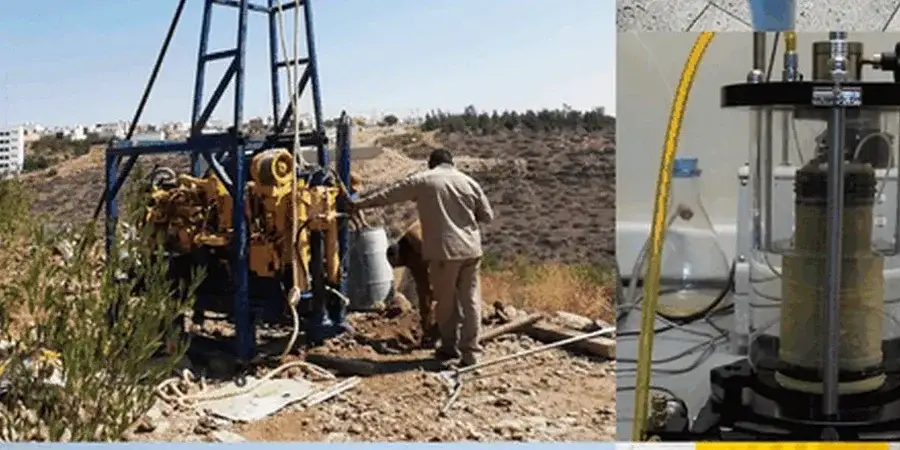
Local geotechnical conditions in Aurora Illinois
Aurora’s population surpassed 180,000 in the 2020 census, and the pressure to develop former agricultural land on the city’s periphery has pushed pavement construction onto soils that were never engineered for heavy traffic. The biggest risk is designing with unsoaked CBR values. A silty clay from the Equality Formation can lose 60 to 70 percent of its bearing capacity after four days of saturation, and Aurora’s frost depth of 42 inches guarantees seasonal moisture cycles that saturate the subgrade every spring. We have seen projects where the design CBR was assumed at 8 based on a quick hand penetrometer test in dry August conditions, only to have the pavement rut within two winters because the true soaked CBR was 2.5. The IDOT subgrade stability manual requires soaked CBR for all permanent roads, and we run the full 96-hour swell-and-penetration procedure without shortcuts. For sites where the subgrade CBR falls below 3, the liquefaction potential under seismic loading becomes a secondary concern, particularly in the saturated sand lenses mapped by the Illinois State Geological Survey in the Fox River floodplain.
Our services
Our laboratory CBR testing program in Aurora supports pavement designers, geotechnical consultants, and municipal engineers with data that goes directly into AASHTO 1993 layer design equations. Each test includes a full moisture-density relationship, swell monitoring, and penetration curves with corrections where applicable.
Soaked CBR with Swell Measurement
The full ASTM D1883 procedure with 96-hour submergence under calibrated surcharge weights. We record swell at 24-hour intervals and report the corrected CBR at 0.1 and 0.2 inches of penetration. This is the standard for all IDOT and municipal road projects in the Fox River Valley.
Unsoaked CBR for Temporary Works
Immediate penetration testing on specimens compacted at optimum moisture without soaking. Used for temporary haul roads, crane pads, and construction staging areas where the subgrade will not experience long-term saturation. We always note that these values should not be used for permanent pavement design.
CBR Correlation with DCP and Gradation
For preliminary site investigation, we pair laboratory CBR with field Dynamic Cone Penetrometer data and grain size analysis to build a correlation specific to the Aurora site geology. This allows the design team to estimate CBR variability across the site without running dozens of laboratory specimens.
Common questions
How much does a laboratory CBR test cost in Aurora?
The standard ASTM D1883 soaked CBR test on a single remolded specimen runs between US$120 and US$190, depending on whether a full moisture-density curve (Proctor) is required and whether multiple compaction energies are specified. We recommend running at least three points to define the CBR-versus-density relationship, which brings the total to roughly US$360 to US$570 for a complete subgrade evaluation.
Why does IDOT require a 96-hour soaking period for CBR?
The 96-hour soak simulates the worst-case saturation scenario that a subgrade will experience over its service life. In Aurora, where the frost depth reaches 42 inches and spring thaw saturates the subgrade for weeks, the soaked CBR is the only value that reliably predicts long-term pavement performance. A soil that tests at CBR 12 unsoaked can drop to CBR 3 or lower after full saturation.
Can you test in-situ soil samples from our Aurora site, or do you only run remolded specimens?
ASTM D1883 is fundamentally a laboratory test on remolded, compacted specimens. We prepare the soil at the target moisture and density that will be achieved during construction compaction. If you need a direct in-situ bearing capacity measurement, we recommend complementing the laboratory CBR with a field CBR test using a load truck and jack, or with a Dynamic Cone Penetrometer correlated to CBR.
What CBR value do Aurora building codes require for residential driveways?
The City of Aurora typically follows IDOT standards for public roads and ACI or PCA guidelines for residential flatwork. Most driveway designs assume a subgrade CBR of 3 to 5 percent. On the silty clays common in the west side subdivisions, achieving that often requires overexcavation and replacement with CA-6 compacted aggregate. We can run a CBR on the compacted subgrade after preparation to verify the design assumption before concrete placement.