The soil story changes completely between downtown Aurora and the newer developments out by Fox Valley. Near the Fox River, you hit soft alluvial silts and organic layers within the first ten feet. Five miles west, the glacial till is stiff and packed with gravel. That contrast drives everything about our geotechnical excavation monitoring approach. In the river corridor we watch for settlement around adjacent brick buildings built in the 1880s. Out west the concern shifts to boulder obstructions and perched groundwater in the till. We set up inclinometers, survey prisms, and vibration monitors differently in each zone. The team has logged enough boreholes across Kane County to know the transition lines — where the soil profile flips from river deposit to Wisconsinan till — and we calibrate our alarm thresholds accordingly. For deeper cuts near the old Copley Hospital site or the new pedestrian bridge footings we often pair the monitoring plan with deep excavation analysis to anticipate base heave before the first bucket goes in.
In Aurora's river corridor, one unexpected sand seam can change the shoring loads overnight — our monitoring catches that shift before it becomes a problem.
Technical details of the service in Aurora Illinois
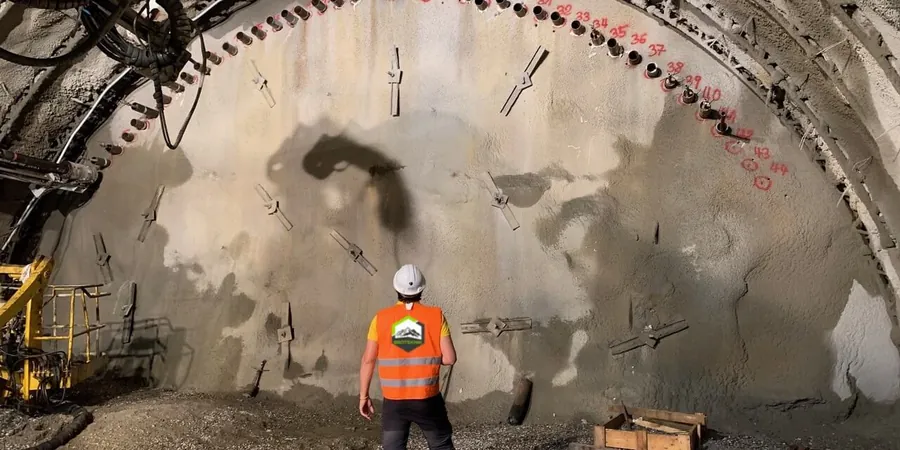
Local geotechnical conditions in Aurora Illinois
The rig we use most often for Aurora monitoring is a lightweight CPT unit on tracks — it can squeeze between buildings on the east side without shutting down an alley. We push piezocones to track pore pressure response during dewatering, because a lot of the older structures downtown rest on timber piles. If you drop the water table too fast, those piles start to rot the moment air hits them. We see it happen. The same rig carries a seismic cone for shear-wave velocity checks when the excavation exposes a contact between the till and the underlying dolomite. Another piece of kit we rely on is a robotic total station set on a fixed pillar outside the zone of influence — it scans prism arrays every fifteen minutes and sends alerts if settlement accelerates. In Aurora the biggest risk is differential movement. The soil can be stiff clay on one side of the cut and loose hydraulic fill on the other, and the shoring system reacts unevenly. Monitoring gives the contractor the evidence to adjust tieback tension or add bracing before anyone on the street notices a crack.
Our services
Our monitoring work in Aurora covers the full timeline of an excavation project, from the pre-construction survey through the backfill phase.
Pre-Excavation Condition Surveys
We document existing cracks, foundation offsets, and pavement conditions on all structures within the zone of influence. Photographs, crack gauges, and benchmark elevations create the baseline.
Real-Time Shoring Performance Monitoring
In-place inclinometers, load cells on tiebacks, and automated total stations feed data to a cloud dashboard. The engineer of record sees movement trends the same day they develop.
Vibration and Settlement Control
Seismograph deployment during rock excavation and demolition, with PPV limits calibrated to Aurora's historic district requirements. Settlement plates and deep benchmarks track vertical movement.
Common questions
How much does geotechnical excavation monitoring cost for a typical Aurora project?
For most projects in Aurora, monitoring programs fall between US$840 and US$2.190 depending on the number of instruments installed and the duration of the excavation. A small trench job next to a single structure runs on the lower end. A deep basement with multiple inclinometers, automated survey, and vibration monitoring across several months reaches the upper range.
What triggers an alarm during excavation monitoring in Aurora?
We set project-specific thresholds based on the response ratio of adjacent structures. Typically, lateral movement exceeding 0.25 inches cumulative or 0.10 inches in a single 24-hour period triggers a notification. For vibration, we follow the 0.25 in/sec PPV limit that the City of Aurora applies to historic masonry. Settlement alarms activate at 0.50 inches total with angular distortion approaching 1/500.
How do you handle monitoring when groundwater is encountered?
We install vibrating-wire piezometers at multiple depths to track the water table during dewatering. Readings are taken every four hours initially, then adjusted based on drawdown rate. If the water level drops faster than modeled, we check for effects on nearby timber pile foundations and adjust the dewatering plan before damage occurs.