Aurora’s east and west sides sit on surprisingly different ground. The east side, closer to the Fox River, often hits soft alluvial silts and clays within the first 10 feet, while the west side, particularly around the Orchard Road corridor, transitions into dense granular tills with occasional cobbles. This contrast means a retaining wall design that works near Phillips Park might need a completely different foundation approach out by the Chicago Premium Outlets. When we start a new wall project, the first call is usually for a test pits exploration to visually log the stratigraphy, because Aurora’s glacial history left a mosaic of deposits that core borings alone don’t always capture. Once we have the soil profile, we tie it into the IBC 2021 lateral earth pressure tables and ASCE 7-22 load combinations to size the stem, heel, and key.
In Aurora’s Fox River silts, hydrostatic pressure behind a wall often governs the design — not the reinforced concrete section itself.
Technical details of the service in Aurora Illinois
Working video
Local geotechnical conditions in Aurora Illinois
Aurora’s freeze-thaw cycles are brutal on retaining structures. With an average of over 120 freeze-thaw days per year according to Illinois State Water Survey data, the frost depth here reaches 42 inches per IBC Figure 1809.5. If the wall footing isn’t set below that line in frost-susceptible silts, you get differential heave that cracks the facing panels by year three. The other big variable is the Fox River’s influence — in the floodplain, groundwater can sit just 3 to 4 feet below grade in spring, which saturates the backfill and dramatically increases lateral pressure. We factor in both hydrostatic and seismic increment loads using the Mononobe-Okabe method, because Aurora sits in a region where the USGS seismic hazard maps show a 0.15–0.20g peak ground acceleration at the 2,475-year return period. Overlooking that seismic component in a gravity wall design can lead to a sliding failure during an event that the structural code alone won’t catch.
Our services
Our retaining wall design scope in Aurora covers everything from the initial subsurface investigation through to construction-phase observation. We work with segmental block suppliers, precasters, and cast-in-place contractors across Kane County.
Cantilever & Gravity Wall Engineering
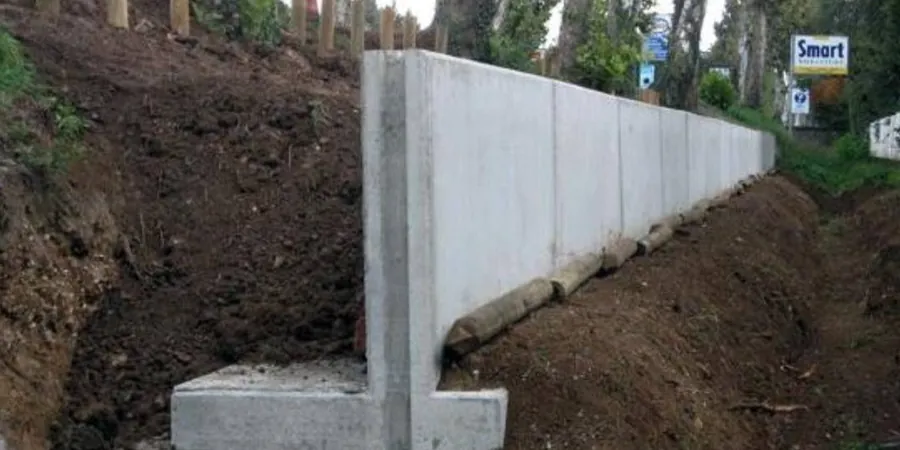
We design cast-in-place and segmental block walls up to 20 feet, with full bearing, overturning, and sliding checks per IBC and ACI 318. Each design package includes backfill specifications, drainage details, and reinforcement schedules. For walls near property lines, we coordinate with the City of Aurora building department on zoning setbacks.
MSE & Reinforced Soil Walls
For taller walls and infrastructure projects, we use FHWA-NHI-10-024 methodologies to design mechanically stabilized earth walls with geogrid or metallic reinforcement. We specify the gradation, friction angle, and electrochemical properties of the reinforced fill, and we supervise pullout testing on-site to confirm the interaction coefficients assumed in design.
Common questions
What’s the typical cost for a retaining wall design in Aurora?
For a typical residential retaining wall under 6 feet, the design package runs from US$1,150 to US$2,800. For commercial or taller MSE walls requiring global stability and seismic analysis, the engineering cost ranges from US$2,800 to US$4,550, depending on the number of soil borings and laboratory tests needed.
Does Aurora require a permit for a retaining wall?
Yes. The City of Aurora requires a building permit for any retaining wall over 4 feet in height measured from the bottom of the footing to the top of the wall. The submittal must include stamped engineering drawings, a soils report, and drainage details. Walls under 4 feet still need to comply with zoning setbacks but typically don’t require a structural permit.
How do you handle the high groundwater in the Fox River valley?
We design the drainage system to handle the worst-case spring groundwater level. That usually means a continuous granular drainage blanket behind the wall, 4-inch perforated collection pipes at the base, and weep holes at 6-foot spacing. In silty soils, we add a filter fabric wrap to prevent fines from clogging the drain. We also check the buoyancy and seepage forces under flood conditions.
What soil tests are needed before designing a retaining wall in Aurora?
At minimum, we run Atterberg limits, grain-size distribution, and a consolidated-drained direct shear test on the foundation and backfill soils. For taller walls or soft clays, we add consolidation tests to estimate settlement and triaxial tests for undrained strength. If the wall is in the Fox River floodplain, we also run permeability tests to design the drainage system correctly.