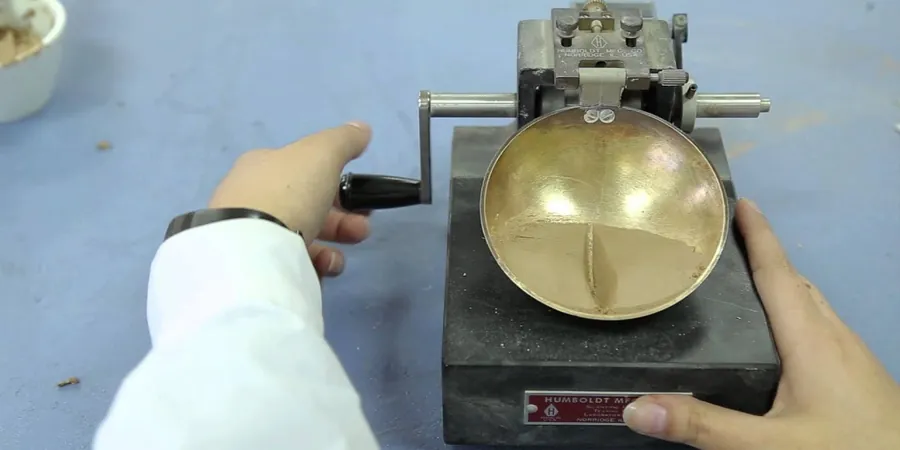
A warehouse expansion project off Butterfield Road stalled last spring because the compacted fill kept failing density checks. The contractor had moisture content numbers but couldn't figure out why the silty clay wouldn't behave. Turns out the material was sitting right at its liquid limit after a week of rain, and nobody had run the index tests to flag it. That scenario plays out more often than you'd think across Kane County. Atterberg limits testing gives you the plasticity range of a soil, the boundary between brittle and plastic behavior, and a direct window into how it will react to water and compaction energy. We run the full suite, liquid limit, plastic limit, and plasticity index, following ASTM D4318 with calibrated Casagrande cups and manual thread-rolling, not just a quick lab guess. For any project involving excavation, fill placement, or pavement subgrade in the Fox River watershed, these numbers are not optional. They tell you whether you can compact that clay today or need to wait three days, and that decision has real cost implications.
Plasticity index is not just a number on a lab report. It is a direct predictor of how much a soil will move under seasonal moisture changes, and in Aurora's freeze-thaw climate, that movement is cumulative.
Technical details of the service in Aurora Illinois
Local geotechnical conditions in Aurora Illinois
The most common mistake we see in Aurora is a contractor assuming that a proctor curve is enough to qualify fill material without knowing the Atterberg limits. Here is the problem: a proctor tells you optimum moisture and maximum dry density, but it does not tell you whether the soil at that moisture content is brittle or plastic. If your fill has a PI of 30 and you are compacting at optimum, you might be placing a material that will heave every spring and crack slab-on-grade floors within two years. Another scenario we encounter is earthwork specs that call for moisture conditioning within two percent of optimum, but nobody checked whether that soil's plastic limit is actually above optimum, meaning you would be placing it dryer than the plastic limit, which is nearly impossible to compact in cohesive material. On one industrial site near the Aurora Municipal Airport, the geotech report flagged a CL-ML layer with a PI of only 8, and the contractor treated it like a standard clay, over-wetting it until it pumped under the sheepsfoot roller. The lab data was there; the interpretation was missing. That is the gap we close.
Our services
Atterberg limits data is most useful when integrated with other index and performance tests. We run these in combination depending on your project requirements:
Full Atterberg Suite
Liquid limit by Casagrande multi-point method, plastic limit by hand thread rolling, and calculated plasticity index with USCS classification assignment.
Moisture Content Correlation
Field moisture determination paired with Atterberg limits to calculate liquidity index and assess in-situ soil consistency for compaction planning.
Sieve Analysis Integration
Combined grain size distribution and Atterberg limits for complete USCS classification, including clay fraction for activity calculation.
Subgrade Evaluation Package
Atterberg limits plus proctor density and laboratory CBR for pavement design in accordance with IDOT and Aurora municipal standards.
Common questions
What do Atterberg limits actually tell me about my Aurora site soil?
They define the moisture content boundaries where your soil changes from a brittle solid to a plastic, moldable material, and eventually to a viscous liquid. For a contractor in Aurora, the plastic limit tells you the driest moisture at which the soil can still be remolded without crumbling, which is critical for compaction. The liquid limit indicates where the soil loses shear strength entirely. The plasticity index, the difference between the two, correlates directly with shrink-swell potential, which matters a lot in our freeze-thaw climate.
How much does Atterberg limits testing cost in Aurora?
A full Atterberg suite, liquid limit and plastic limit with plasticity index calculation, typically runs between US$60 and US$100 per sample in the Aurora area. The exact cost depends on whether you need rush turnaround, multiple-point liquid limit versus single-point, and whether the sample requires pretreatment to remove organic matter. We quote per sample with volume discounts for larger earthwork projects.
How long does the test take from sample submission to report?
Standard turnaround is two to three business days for a complete Atterberg suite on a single sample. The liquid limit portion requires the soil to hydrate for at least 16 hours before testing, per ASTM D4318, so there is a hard minimum on prep time. Rush service with overnight hydration and same-day reporting is available when the schedule demands it.
Do I need Atterberg limits if I already have a proctor test result?
Yes, and this is one of the most misunderstood points in earthwork QC. A proctor test gives you a compaction curve, optimum moisture, and maximum dry density, but it says nothing about the plasticity range of the soil. You can have two materials with identical proctor curves but completely different Atterberg limits, and their field behavior during compaction and under seasonal moisture cycling will be entirely different. The tests answer different questions and both are necessary for cohesive soils.
What soil types in the Aurora area typically need Atterberg testing?
Any cohesive soil, silts and clays classified as ML, CL, MH, or CH under the USCS, should be tested for Atterberg limits. In the Aurora area, the glacial till and lacustrine deposits that dominate subsurface conditions are predominantly lean clays (CL) with occasional fat clay pockets near old drainage channels. Even silty sands with enough fines content to pass the No. 200 sieve can benefit, because a small clay fraction can dramatically change the soil's response to moisture. More info.