Ground improvement in Aurora, Illinois, encompasses a specialized set of geotechnical engineering techniques aimed at enhancing the mechanical and hydraulic properties of native soils to support structural loads safely and economically. In a region where urban redevelopment and infrastructure expansion are constant, these methods are not merely optional; they are often the critical path between a stalled project and a feasible design. This category covers the analysis, design, and verification of systems that increase bearing capacity, reduce total and differential settlements, mitigate liquefaction potential, and accelerate consolidation. For developers and municipal planners, understanding these solutions is essential to managing risk on sites underlain by weak or compressible deposits.
The local geology of Aurora presents a compelling case for advanced ground treatment. The city is situated within the Fox River Valley, where the near-surface stratigraphy is dominated by Wisconsinan-age glacial till, outwash, and lacustrine deposits. These soils are notoriously variable, frequently including loose sands, sensitive silts, and soft, highly compressible clays. In many areas, particularly near the river and its tributaries, thick sequences of organic silts and peats are encountered at depths that make traditional deep foundations prohibitively expensive. Loose granular layers also raise concerns for seismic-induced liquefaction, despite Illinois’ moderate seismicity. A thorough geotechnical investigation is the mandatory first step to characterize these challenging conditions and select an appropriate improvement strategy.
Any ground improvement design in Aurora must comply with the governing regulatory framework, which begins with the 2018 International Building Code (IBC) as adopted by the State of Illinois and locally enforced by the City of Aurora’s Building and Permits Division. The design methodology is deeply rooted in the geotechnical standards set by the American Society of Civil Engineers (ASCE), specifically ASCE 7 for load combinations and seismic design parameters. Furthermore, all earthwork and deep foundation testing must adhere to the relevant ASTM International standards, such as ASTM D1586 for Standard Penetration Tests and ASTM D1143 for static load testing. The Illinois Department of Transportation (IDOT) Standard Specifications for Road and Bridge Construction also provide a critical reference, particularly for public works and transportation projects, dictating material specifications and quality control protocols for techniques involving aggregates and grouting.
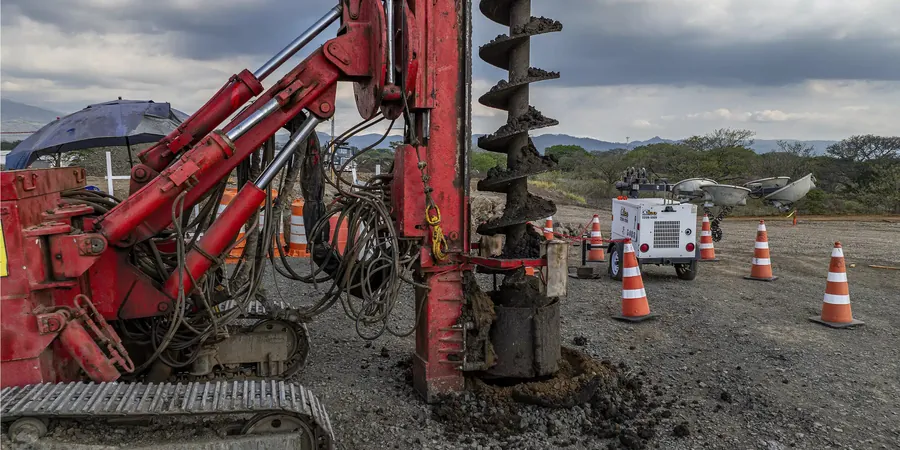
The types of projects in Aurora that routinely require ground improvement are diverse. Large-footprint commercial structures, such as warehouses and distribution centers on the city’s outskirts, frequently encounter compressible clays that demand preloading with wick drains or the installation of rigid inclusions to control floor slab settlements. For heavily loaded structures like mid-rise buildings and water tanks on sites with loose granular soils, deep vibratory methods are often the most efficient solution. Our specialized stone column design provides a proven approach to reinforce soft cohesive soils and silty sands, creating a composite ground mass with enhanced stiffness and drainage. In parallel, for sites dominated by clean, loose sands susceptible to collapse or liquefaction, vibrocompaction design offers a densification technique that increases relative density and frictional strength, mitigating risk without importing massive quantities of fill. Bridge approaches, road embankments, and slope stabilization projects also rely on these technologies to ensure long-term performance and safety.
Available services
Common questions
What is the primary goal of ground improvement instead of just using deep foundations?
The primary goal is to create an economical, monolithic building platform by enhancing the mass properties of the in-situ soil. Unlike deep foundations that bypass weak soil, ground improvement treats it to bear loads directly. This eliminates the need for structural floor slabs, reduces differential settlements across large areas, and often results in a faster construction schedule with less concrete and steel.
How do I know if my Aurora site requires ground improvement before construction?
The necessity is determined by a comprehensive geotechnical investigation. If borings reveal loose sands with Standard Penetration Test (SPT) N-values below 15, soft clays with undrained shear strengths under 1,000 psf, or the presence of organic soils and uncontrolled fill, then ground improvement is likely required. The analysis will show if predicted settlements exceed the project’s total and differential settlement tolerances under the design loads.
What are the key differences between treating sandy soils and clayey soils?
The treatment mechanism differs fundamentally. Clean, granular soils like sands are improved through densification, using vibration to rearrange particles into a tighter state, which is ideal for vibrocompaction. Cohesive soils like clays and silts are improved through reinforcement and drainage, where stone columns are installed to create a stiffer composite mass and provide a radial drainage path to accelerate consolidation under load.
Which local building codes and standards govern ground improvement work in Aurora?
Work is governed by the City of Aurora’s adopted International Building Code (IBC) and the Illinois Department of Transportation (IDOT) specifications for public projects. The design must follow ASCE 7 for loading and seismic criteria. Quality control relies on ASTM standards for field testing, such as cone penetration tests (CPT) and load tests, to validate that the improved ground meets the specified performance criteria for bearing capacity and settlement.