The Fox River valley carved through Aurora's glacial terrain, leaving a patchwork of silty clays, fine sands, and occasional gravel lenses that vary over short distances. Builders who assume uniform soil often get surprised. Our grain size analysis gives you the particle distribution data that underpins every meaningful geotechnical decision—from selecting filter media for retaining walls to predicting frost susceptibility. In Aurora, where floodplain deposits meet Wisconsinan till, skipping a hydrometer test on fine-grained material can misclassify a soil by two USCS groups. We pair standard sieve stacks with ASTM D7928 sedimentation methods, delivering full-range curves down to the clay fraction. For deeper exploration, spt-drilling provides disturbed samples our lab processes for grain size, giving you both stratigraphy and gradation in one field campaign.
A 7-gram hydrometer reading at 2 microns tells you more about drainage behavior than a thousand field observations.
Technical details of the service in Aurora Illinois
Our Aurora lab runs grain size tests daily, and we calibrate hydrometers against the specific water chemistry pulled from the City of Aurora's Fox River supply—small detail, but it keeps dispersion consistent. For jobs where compaction control matters just as much as gradation, we often combine grain size curves with proctor-tests to define moisture-density relationships on the same borrow material. Turnaround is typically 48 hours for routine projects; rush turnaround available when the concrete pump is waiting.
Local geotechnical conditions in Aurora Illinois
Aurora sits at roughly 640 feet elevation along the Fox River, and the city’s older neighborhoods—particularly the near-east side—are underlain by lacustrine silts with 60-90% passing the No. 200 sieve. These soils are frost-susceptible and prone to capillary rise. Without a hydrometer analysis, a geotech might assign a generic ML classification and move on. The real risk: underestimating the clay fraction leads to undersized footing drains, and water ponds against foundation walls during the February freeze-thaw cycles Aurora sees every year. We’ve also seen projects near the Aurora Transportation Center where imported granular fill was specified as “well-graded gravel” but turned out to be gap-graded—a grain size curve caught it in one afternoon. The test is simple, but the cost of skipping it compounds fast when subgrade fails.
Our services
We provide grain size testing as both a standalone service and integrated into broader geotechnical investigations across the Aurora area. Every report includes the full gradation table, semi-log plot, D-values, and USCS symbol.
Sieve Analysis (Coarse + Fine)
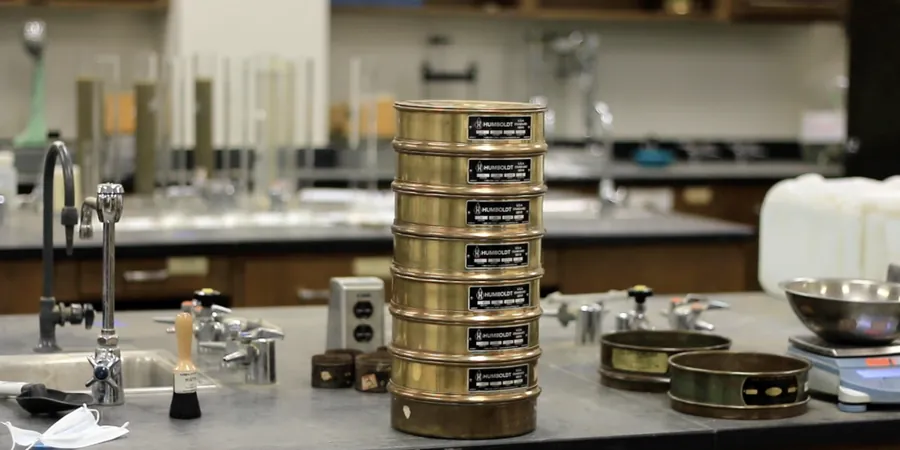
Mechanical sieving from No. 4 through No. 200 per ASTM D6913. Suitable for sands and gravels with limited fines. We oven-dry, wash, and re-dry the minus-200 fraction for accurate split.
Hydrometer Sedimentation (Clay Fraction)
ASTM D7928 hydrometer test using 152H scale. Readings at 0.5, 1, 2, 4, 8, 15, 30, 60, 120, 240, and 1440 minutes. We report % clay, % silt, and colloid activity where Atterberg limits are available.
Combined Sieve + Hydrometer Curve
Full-range particle size distribution from 75 mm down to 1 micron. Used for USCS classification, filter design, and drainage modeling. Digital data export to DXF or CSV for AutoCAD integration.
Field Sampling Kits (Aurora Pickup)
We provide sample bags, jars, and chain-of-custody forms at our Aurora drop-off point. Disturbed samples accepted in 1-gallon zip bags; minimum mass depends on maximum particle size per ASTM D75.
Common questions
How much soil do you need for a grain size test in Aurora?
For sandy soils with particles up to 3/8 inch, we need about 500 grams of oven-dried material. For fine-grained silts and clays, 200 grams is usually sufficient. If you have gravel larger than 3/4 inch, we will need more material—call us and we can advise based on the maximum particle size you are seeing on site.
What does a grain size analysis cost in the Aurora area?
A standard sieve analysis (ASTM D6913) runs about US$90. Adding the hydrometer sedimentation test (ASTM D7928) brings the total to roughly US$130 to US$220, depending on whether we need to run parallel specimens for quality control. Combined sieve-and-hydrometer curves are the most common request we process for Aurora projects.
How long does it take to get grain size results?
Standard turnaround is two business days. The hydrometer portion requires a 24-hour sedimentation period, so rush service for a combined curve is still typically next-day. If you only need the sieve portion (coarse fraction), we can often deliver same-day results when samples arrive before 10 AM.
Do you use sodium hexametaphosphate as a dispersant for the hydrometer test?
Yes, we prepare a 40-gram-per-liter solution of sodium hexametaphosphate per ASTM D7928. We also check the pH and hardness of our mix water regularly because Aurora’s municipal supply from the Fox River can vary seasonally, and water chemistry affects dispersion behavior in fine-grained soils.