Aurora sits on the edge of the St. Charles bedrock valley, buried under 50 to 100 feet of glacial drift. That means dense Wadsworth Till overlying silty outwash — and N-values that can swing from 8 to refusal within five vertical feet. We run SPT borings across Kane County with automatic trip hammers calibrated to ASTM D1586-18 energy ratios. Every blow count gets normalized to N60 and correlated against USCS classifications from split-spoon samples. For deep foundations near the Fox River floodplain, we log N-values every 2.5 feet and flag any loose granular seams that could trigger liquefaction under the MCE ground motion in ASCE 7-22.
N-values in Aurora's Wadsworth Till commonly hit refusal above 50 blows — that's dense glacial hardpan, not weathered shale.
Technical details of the service in Aurora Illinois
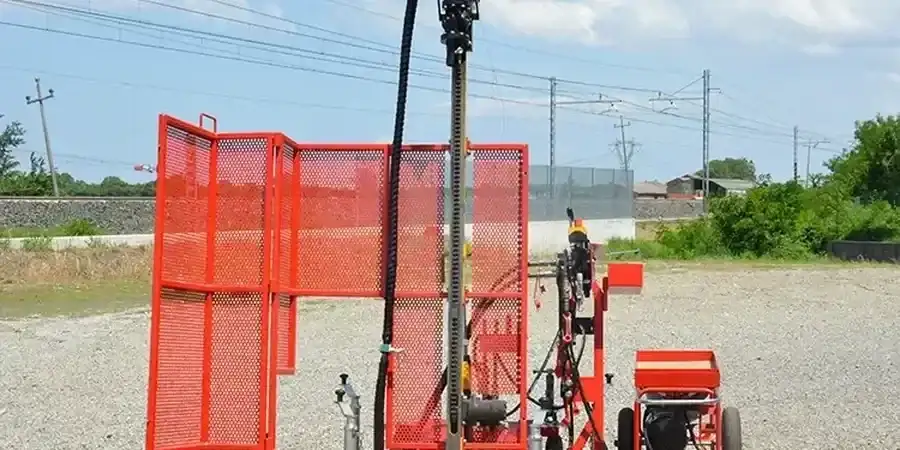
Local geotechnical conditions in Aurora Illinois
IBC Section 1803 requires soil borings for any foundation design in Seismic Design Category C or higher — which covers most of Aurora given the proximity to the Sandwich Fault Zone. Skipping SPT in the Fox River corridor risks missing loose silty sand lenses at 15-25 feet depth. These layers can densify under cyclic loading and drop bearing capacity during a design-level earthquake. We flag N-values below 6 in saturated granular soils and recommend cyclic triaxial follow-up per ASTM D5311 when liquefaction potential is high. Clay seams with N<4 demand consolidation testing to estimate settlement under mat foundation loads. Our borehole logs include groundwater depth measured at 24 hours and again at completion.
Our services
We deliver SPT field data that foundation engineers can use directly — no recalibration needed.
SPT Borehole Drilling
Hollow-stem auger borings to 100+ feet with split-spoon sampling every 2.5 feet. Real-time N-value logging, moisture description, and sample bagging for lab testing.
N60 and N1(60) Correction
We correct raw blow counts for hammer energy, rod length, borehole diameter, and overburden pressure. Final values tied to ASCE 7 site class determination.
Borehole Logs with USCS Classification
Stratigraphic columns with USCS group symbols, density/consistency, SPT N-values, and groundwater depth. Delivered as signed PDF and editable gINT files.
Common questions
How deep do you typically drill SPT borings in Aurora?
Most borings reach 40 to 60 feet — enough to penetrate the glacial drift and confirm refusal on bedrock. For deep foundations near the Fox River we extend to 80-100 feet to characterize alluvial deposits fully. Depth is always confirmed against the project's boring layout plan.
What does an SPT boring program cost in Aurora?
A standard program with 3-5 borings to 50 feet depth typically ranges from US$510 to US$830 per boring, depending on access, traffic control needs, and laboratory testing scope. Mobilization and traffic control permits are quoted separately after site visit.
How do you handle SPT refusal in dense glacial till?
When we hit 50 blows for 6 inches or less penetration, we record refusal and switch to rock coring if the project requires bedrock confirmation. We note the refusal depth on the log and classify the material as very dense till based on cuttings and adjacent boring data.
Can SPT N-values be used directly for shallow foundation bearing capacity?
Yes — N60 values correlate to allowable bearing pressure via empirical methods like Bowles or Terzaghi-Peck. We provide corrected N-values and soil descriptions so your geotechnical engineer can select the appropriate correlation for Aurora's till and outwash soils.