The Fox River valley through Aurora exposes a sequence of glacial outwash and lakebed deposits that can challenge conventional shallow foundations. In several borings across the east bank industrial corridor, our team has logged more than 20 feet of soft to medium-stiff silty clay with SPT N-values below 6 before encountering competent till. That kind of profile demands a Improvement strategy that increases bearing capacity and accelerates drainage, which is where stone column design becomes the primary alternative to deep foundations. At the planning stage, we usually pair column layout analysis with test pits to verify fill thickness and groundwater elevation, especially on redeveloped mill sites near the river. Aurora’s mix of old infrastructure and expanding distribution centers means we see everything from lightly-loaded slabs to heavily-loaded rack-supported floors, and the stone column geometry must be tuned accordingly.
Stone columns turn problematic silty-clay profiles into buildable ground by combining densification and radial drainage in a single installation pass.
Technical details of the service in Aurora Illinois
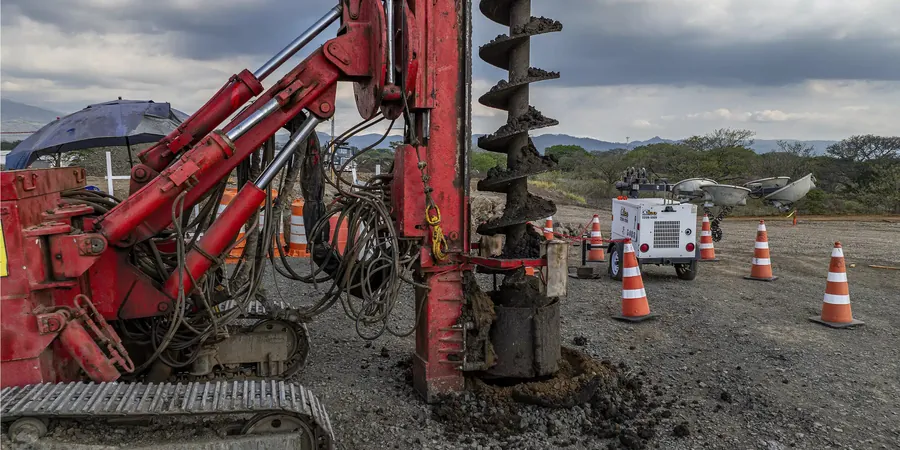
Local geotechnical conditions in Aurora Illinois
The most frequent mistake we see on Aurora projects is ordering vibro-replacement without a site-specific settlement analysis—assuming that a fixed grid will handle all loads. When rack legs impose 8-kip point loads and the column-to-column spacing was set for a uniform floor load of 500 psf, differential settlements can exceed tolerance within months of operation. Another risk is ignoring the smear effect in silt-rich layers: if the vibroflot advances too slowly through transitional strata, the sidewall smearing reduces the radial drainage that stone columns rely on for consolidation acceleration. We address this by specifying the vibroflot tip design, stepwise penetration rates, and air-flush parameters based on the fines content and plasticity index logged in the exploration borings. On sites adjacent to existing structures—common in downtown Aurora’s tight lots—vibration monitoring with triaxial geophones is mandatory to keep peak particle velocity below the threshold that could disturb historic masonry.
Our services
Our Improvement group provides a complete stone column package—from subsurface characterization through modulus testing—so the design is calibrated to actual ground conditions.
Column layout and settlement analysis
We develop optimized grids using finite-element or axisymmetric unit-cell models, checking both total and differential settlement under the client’s floor and rack loading diagrams.
Trial column program and field verification
Before production, we install test columns instrumented with tell-tales and piezometers, then run post-installation CPT or dilatometer tests to confirm the stiffness improvement factor.
Load-transfer platform design
We specify the platform thickness, gradation, and compaction criteria using the Hewlett & Randolph arching method, ensuring stress distribution into the columns.
QA/QC and acceptance testing
Daily reports track stone consumption per column against the theoretical volume, and we perform modulus tests—plate load or zone tests—on at least 5% of the treated footprint.
Common questions
How much does stone column design and testing cost for a typical warehouse site in Aurora?
For a mid-size industrial parcel in the Aurora area, the combined design, trial column program, and QA/QC testing usually falls between US$1,500 and US$5,560, depending on the number of columns, depth of treatment, and the extent of post-installation verification required.
When are stone columns a better choice than driven piles in the Fox River Valley?
Stone columns become the preferred solution when the compressible layer is less than about 35 feet thick and the structure can tolerate modest total settlement. They also provide free-draining paths that accelerate consolidation, which is valuable on low-permeability silty clays common in Aurora’s glacial lake deposits.
What soil types in Aurora respond best to vibro-replacement stone columns?
Soils with fines content below about 30% and plasticity index under 15 respond well to densification alone. In the lean clays and silty clays that dominate much of the Fox River corridor, the primary mechanism is reinforcement and drainage rather than densification, so the column spacing must be adjusted accordingly.
How do you verify that installed stone columns meet the design intent?
We rely on three independent checks: real-time installation logs recording depth, amperage, and stone volume per lift; post-treatment CPT soundings between columns to measure the increase in tip resistance; and zone load tests or plate-bearing tests on a statistical sample of the treated area to confirm the modulus improvement.