Aurora's landscape, carved by the Fox River and layered with glacial tills and outwash deposits, presents specific challenges for any construction near its slopes and ravines. The surficial geology here, dominated by the Wedron Group tills with interbedded sand and gravel lenses, can develop perched water tables that dramatically reduce factor of safety after heavy rain. Our approach integrates subsurface data from the SPT drilling program with limit equilibrium modeling to deliver a stability assessment that reflects actual site conditions. We don't rely on textbook assumptions when a slope's stratigraphy was deposited by the Wisconsin Episode glaciation and subsequently eroded by the Fox River's meanders, creating complex, non-uniform layers that demand rigorous analysis.
In Aurora's glacial terrain, a slope's stability is rarely about a single soil layer—it's the perched water in the sand lenses that often governs the failure mechanism.
Technical details of the service in Aurora Illinois
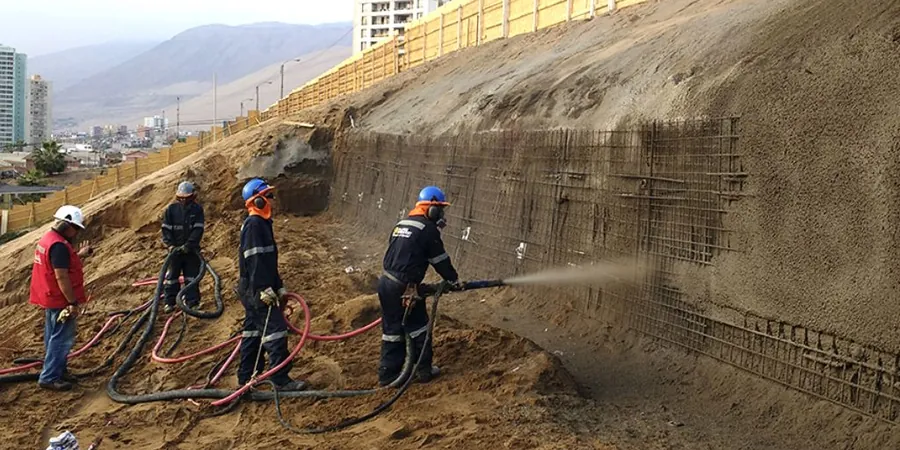
Local geotechnical conditions in Aurora Illinois
The eastward expansion of Aurora from its historic core along the Fox River placed residential and commercial development on bluffs and valley walls that had been stable for millennia under natural conditions. Cutting into these slopes for basements or grading for parking lots has, in several cases, reactivated ancient landslides or triggered new shallow failures in the weathered till zone. The biggest risk we encounter is not a deep-seated rotational failure but a compound slide where the failure surface follows the interface between fill and natural ground, then exits at the toe near a riverbank. Our analysis explicitly searches for these non-circular failure paths using block-specification techniques, ensuring that a slope deemed stable under a simple circular assumption doesn't hide a more critical translational or wedge-type mechanism.
Our services
Our slope stability work in Aurora covers the full spectrum from preliminary screening to detailed design verification, always grounded in site-specific geotechnical data.
Limit Equilibrium Analysis
Spencer and Morgenstern-Price methods applied to Aurora's glacial stratigraphy, with search routines optimized for sand-lens-triggered failures.
Seismic Pseudostatic Assessment
Incorporating Aurora's ASCE 7-22 mapped spectral accelerations to evaluate slope performance under the design earthquake.
Groundwater Impact Modeling
Transient seepage analysis to quantify the effect of rapid drawdown or spring thaw on pore pressure distribution and factor of safety.
Stabilization Design Support
Parameter development for retaining structures, soil nailing, or regrading schemes, verified against our stability models.
Common questions
What factor of safety is required for a permanent slope in Aurora?
Per IBC 2021 and FHWA-NHI-05-123, we target a minimum static factor of safety of 1.5 for permanent slopes under long-term drained conditions. For temporary construction slopes, a minimum of 1.3 is acceptable provided OSHA 1926 Subpart P requirements for worker safety are met. These values assume laboratory-measured effective stress parameters and realistic groundwater assumptions.
How do you account for the Fox River's influence on slope stability?
The Fox River affects slopes through toe erosion during flood events and by controlling the regional groundwater base level. We model rapid drawdown scenarios where the river level drops faster than the slope can drain, creating excess pore pressures that reduce effective stress. Our analysis also evaluates the long-term retreat of the riverbank and its impact on the geometry of the critical failure surface.
What is the typical cost range for a slope stability analysis in Aurora?
A complete slope stability analysis for a typical residential or commercial lot in Aurora generally ranges from US$1,200 to US$4,580. The final cost depends on the slope height, the complexity of the stratigraphy, whether existing subsurface data is available, and the need for specialized laboratory testing such as consolidated-undrained triaxial with pore pressure measurement.