A 24-channel seismograph system with 28-Hz geophones deployed in linear spreads of up to 230 feet captures the energy from a 16-pound sledgehammer source striking an aluminum plate. That is the typical field setup our technical crew mobilizes across Aurora’s glacial terrain—where the Fox River has carved through Wisconsin Episode till and outwash deposits. The geophone array records P-wave and S-wave arrivals at 0.125-millisecond sampling intervals, generating travel-time curves that feed into tomographic inversion algorithms. For deep bedrock profiling along the I-88 corridor expansion zones, we often pair this with a seismic refraction survey using 48-channel spreads to resolve the contact between the Ordovician dolomite and the overlying Quaternary sediments. The resulting 2D velocity cross-sections reveal lateral variations that standard borehole logging cannot capture, particularly where paleo-channels filled with compressible organic silts intersect proposed footing locations.
Seismic velocity contrasts between glacial drift and dolomite bedrock in Aurora produce a first-arrive crossover distance that reliably identifies the soil-rock interface within ±3 feet.
Technical details of the service in Aurora Illinois
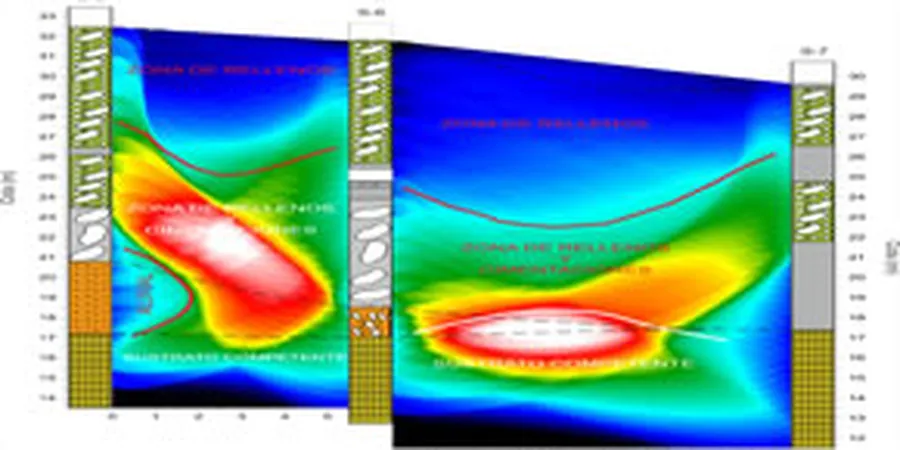
Local geotechnical conditions in Aurora Illinois
Aurora sits at an elevation of 676 feet above sea level on the Fox River floodplain, and the USGS Quaternary geologic map of Kane County reveals a buried bedrock valley—the Aurora Bedrock Valley—trending southwest to northeast beneath the city center. This paleo-topography creates abrupt velocity contrasts that, if unresolved, produce seismic reflection artifacts and incorrect depth-to-bedrock estimates. The 2010 M5.2 earthquake near the Sandwich Fault Zone, felt across Aurora, reminded structural engineers that northern Illinois is not aseismic; the IBC design spectral response acceleration for the area demands a Site Class determination that depends directly on shear-wave velocity in the upper 100 feet. Seismic tomography that skips S-wave acquisition leaves the Vs30 parameter unknown, forcing conservative assumptions that inflate foundation costs. For deep excavations and retention systems near the Fox River’s high groundwater table, the combination of seismic stratigraphy and borehole control reduces the risk of mischaracterizing the stiffness contrast between the Lemont Formation till and the softer Equality Formation silts.
Our services
Our seismic tomography program in Aurora integrates multiple geophysical techniques to address the full range of subsurface characterization needs—from shallow utility corridor investigations to deep bedrock profiling for high-rise foundations.
Refraction Tomography for Bedrock Mapping
Multi-channel P-wave refraction surveys with first-arrival picking and travel-time inversion produce continuous 2D bedrock surface profiles. We apply the Generalized Reciprocal Method for refractor geometry and run tomographic iterations to resolve velocity gradients within the glacial drift. The output includes a contoured bedrock surface with elevation accuracy within ±3 feet, essential for projects where the Ordovician dolomite surface controls excavation depth and foundation bearing capacity. Each survey line is tied to existing borehole logs from the Illinois State Geological Survey database for ground-truth calibration.
Multi-Channel Reflection Profiling for Deep Targets
For mapping fracture zones, solution cavities, and structural features in the Galena-Platteville dolomite sequence below 100-foot depth, we deploy common-midpoint reflection surveys with 12-fold to 24-fold coverage. Processing includes elevation statics correction, frequency-wavenumber filtering, and pre-stack time migration. The resulting seismic sections identify sub-vertical discontinuities that correlate with known joint sets in the Aurora area, providing critical input for liquefaction assessment and deep foundation design where the bedrock integrity controls end-bearing pile performance.
Common questions
How deep can seismic tomography image in Aurora’s glacial geology?
Depth penetration depends on the seismic source energy and geophone spread length, not on the method itself. With a 16-pound sledgehammer and 230-foot spread, we typically map the soil-rock interface to 80–100 feet depth. For deeper targets—such as the base of the Aurora Bedrock Valley at 150 to 200 feet—we deploy an accelerated weight drop source and extend the spread to 460 feet with 48 channels. Reflection profiling can image the Galena-Platteville dolomite stratigraphy to 300 feet when high-fold stacking suppresses the strong ground-roll that dominates the near-surface records in the Fox River valley.
What is the typical cost for a seismic tomography survey in the Aurora area?
A refraction tomography survey in Aurora typically ranges from US$2,740 to US$5,140 depending on the number of seismic lines, the spread length per line, and whether both P-wave and S-wave data are acquired. Factors that influence the final cost include site accessibility along the Fox River corridor, the need for traffic control on arterial roads like Route 25 or Farnsworth Avenue, and the processing requirements for reflection data if deep bedrock targets are specified.
How does seismic tomography compare to MASW for site classification in Kane County?
Both methods measure shear-wave velocity, but they serve different purposes. MASW provides a one-dimensional Vs profile beneath a single array, ideal for rapid Vs30 determination. Seismic tomography produces a continuous two-dimensional velocity cross-section that reveals lateral variations—essential when the Aurora Bedrock Valley creates abrupt changes in soil stiffness across a building footprint. For site classification per ASCE 7-22, we often combine both: MASW for the Vs30 calculation and refraction tomography to map the spatial distribution of velocity layers that control the site period and amplification factors.