We see too many projects in Aurora where shallow footings are specified for soils that simply cannot handle the load without excessive settlement. The Fox River valley and its tributaries have deposited thick sequences of compressible silty clay across much of the city’s west side. When a conventional spread footing fails here, the repair costs dwarf the initial investment in a proper geotechnical investigation. A raft foundation distributes structural loads across the entire footprint, bridging soft spots and reducing differential movement. Before finalizing a mat design, we always verify subsurface conditions with spt drilling to measure N-values at depth, and often run atterberg limits to quantify the expansion potential of local glacial till. This direct data prevents the over-excavation guesswork that inflates project budgets.
A properly designed raft foundation in Aurora’s glacial till can reduce differential settlement by up to 70% compared to isolated footings on the same soil profile.
Technical details of the service in Aurora Illinois
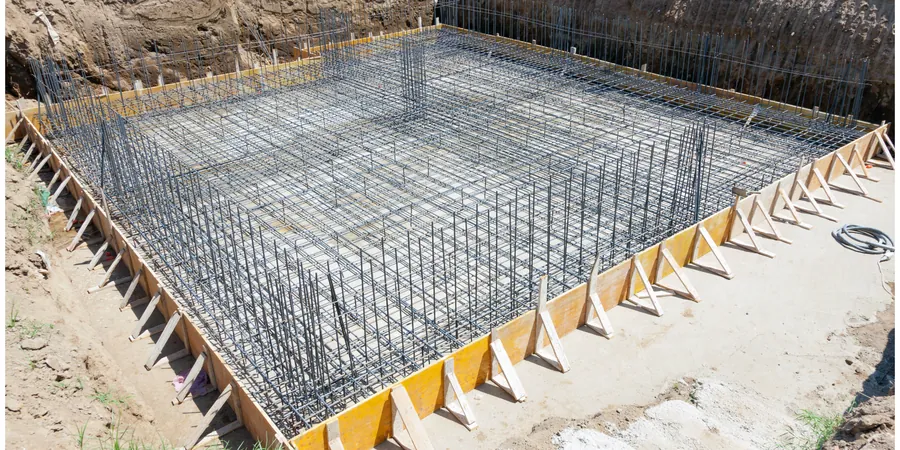
Local geotechnical conditions in Aurora Illinois
In Aurora, we frequently encounter basement slabs cast directly on high-plasticity clay without a capillary break. The clay absorbs moisture, swells, and lifts the center of the slab while the perimeter footings stay fixed by frost walls. The result is cracking that runs diagonally across finished floors. A raft foundation designed without a proper underslab vapor barrier and compacted granular drainage layer is vulnerable to this exact failure mode. We also see problems where the water table rises after construction, exerting uplift pressures that the structural slab was never designed to resist. Our designs include hydrostatic relief systems and thickened edges at column lines to prevent punching shear failures. Ignoring the freeze-thaw cycling in northeastern Illinois guarantees early deterioration of exposed grade beams.
Our services
Our geotechnical support for mat foundations in Aurora covers the full project lifecycle, from initial subsurface exploration through construction observation.
Soil-Structure Interaction Analysis
We develop site-specific modulus of subgrade reaction profiles using plate load tests and SPT correlations. The finite element model incorporates slab thickness variations, column loads, and soil layering to predict settlement contours across the mat.
Construction-Phase Observation and Testing
During mat placement, we monitor subgrade preparation, reinforcing steel placement, and concrete placement procedures. We perform nuclear density testing on the capillary break layer and take concrete cylinders for compressive strength verification at 7 and 28 days.
Common questions
When is a raft foundation necessary instead of spread footings in Aurora?
A raft becomes necessary when the bearing capacity of the near-surface soils is below 2,000 psf, or when the total area of isolated footings exceeds 50% of the building footprint. We also recommend rafts where the glacial till contains soft silt lenses that could cause differential settlement exceeding ½ inch under column loads.
How does frost depth affect raft foundation design in Illinois?
Aurora’s code-mandated frost depth is 42 inches. For unheated slabs, the entire mat perimeter must bear below this depth on non-frost-susceptible fill. We specify a thickened edge beam extending to 48 inches with vertical insulation to decouple the slab from frost action in the surrounding soil.
What does a raft foundation design cost for a commercial building in Aurora?
For a typical commercial structure between 5,000 and 20,000 square feet, the engineering design and geotechnical investigation package ranges from US$970 to US$3,750, depending on the number of borings, laboratory testing scope, and complexity of the structural analysis required.