Aurora sits right on the edge of climate zone 5A, where winter brings an average of 28 inches of snow and the ground freezes hard. That is the first thing we look at when designing rigid pavement here. A concrete slab that works fine in Tennessee will crack apart after three winters in Kane County if the subgrade is not prepared right. Frost depth in this part of Illinois reaches 42 inches according to the International Building Code, and that drives everything from base thickness to joint spacing. Before we pour a single yard of concrete, we look at the soil underneath. That often means pairing the rigid pavement design with a test pits investigation to log the actual layers beneath the grade line, especially in older industrial parcels near the Fox River where fill material is common.
A rigid pavement in Aurora is only as good as its joint load transfer. Lose that, and even 10 inches of concrete will fail.
Technical details of the service in Aurora Illinois
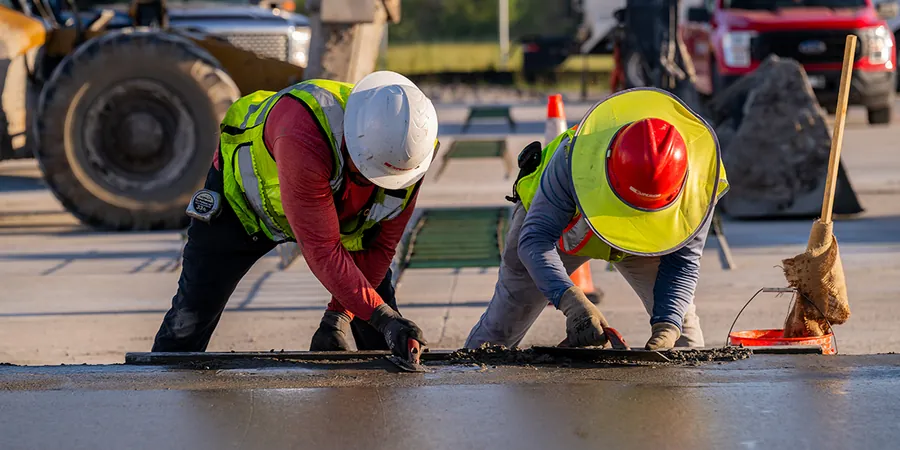
Local geotechnical conditions in Aurora Illinois
The most expensive mistake we see in Aurora is treating a rigid pavement like a flexible one during the earthwork phase. A contractor will proof-roll the subgrade, throw down granular fill, and call it ready. Then the concrete curls at the edges during the first hot summer, the slab corners crack under truck loads, and water gets into the joints. By the following March, freeze-thaw cycles have pumped the fines out from under the slab and created voids. The repair cost at that point often exceeds the original concrete budget. The right sequence is: verify subgrade uniformity, compact to 95% of standard Proctor density, confirm the design k-value is met, and only then place the concrete. Skipping any of these steps voids the design assumptions and leaves the owner with a pavement that will need patching years before it should.
Our services
A rigid pavement design for Aurora conditions involves several technical steps. These are the services we typically perform as part of a complete concrete pavement package.
Subgrade investigation and k-value determination
Field plate load tests or correlations from SPT data to establish the modulus of subgrade reaction specific to your site's soil profile, not an assumed value.
Thickness design per AASHTO and PCA
We run traffic projections, ESAL calculations, and climate adjustments to produce a slab thickness that meets the design life without over-engineering the section.
Joint layout and detailing
Complete joint plan showing contraction, construction, and isolation joints with dowel size, spacing, and tie bar schedules for the expected thermal movement range.
Subbase and drainage design
Gradation specification for the granular subbase, permeability requirements, and edge drain layout where groundwater or poor surface drainage is a concern.
Common questions
How much does a rigid pavement design cost for a project in Aurora?
For a typical commercial or industrial site in Aurora, a complete rigid pavement design package—including subgrade investigation, thickness calculations, and joint detailing—runs between US$2,000 and US$5,990. The final cost depends on the size of the paved area, the traffic loading, and how much existing geotechnical data is available. A small parking lot with light traffic is at the lower end; a heavy-duty truck terminal near the Burlington Northern Santa Fe rail yard requires more analysis and falls at the higher end.
What design method do you use for rigid pavement in Illinois?
We use the AASHTO 1993 Guide for Design of Pavement Structures as the primary method, supplemented by Portland Cement Association (PCA) procedures for jointed plain concrete pavements. The AASHTO method accounts for the specific soil support, traffic loading, and climate conditions we deal with in the Aurora area, including freeze-thaw cycles and spring thaw weakening of the subgrade.
Do you need soil borings before designing a concrete pavement?
Yes, and we will not issue a design without them. The modulus of subgrade reaction, the frost susceptibility of the soil, and the presence of any soft layers all come from the subsurface investigation. In Aurora, where fill material and river-deposited silts are common, assuming a uniform subgrade without borings is the fastest way to get joint faulting and corner cracking within a few years.