In Aurora, we often see clean sands and silty sands just 8 to 12 feet down—material that looks stable but can turn to slurry during a seismic event. The Fox River corridor deposits a mix of alluvium and glacial outwash that masks loose, saturated layers. We run CPT testing to get continuous tip resistance and sleeve friction profiles without disturbing the sample, which catches thin liquefiable seams that SPT alone might miss. Then we cross-check with MASW surveys for shear wave velocity, feeding site class determination under ASCE 7-22 Chapter 20. Aurora sits about 40 miles west of the Sandwich Fault Zone; it is not the highest seismic zone in the U.S., but the design ground motions from the USGS National Seismic Hazard Model still demand a liquefaction check for any structure classified Risk Category III or IV. Our reports give the factor of safety against liquefaction per Idriss and Boulanger (2014) at every foot of depth, so the structural engineer knows exactly where mitigation starts.
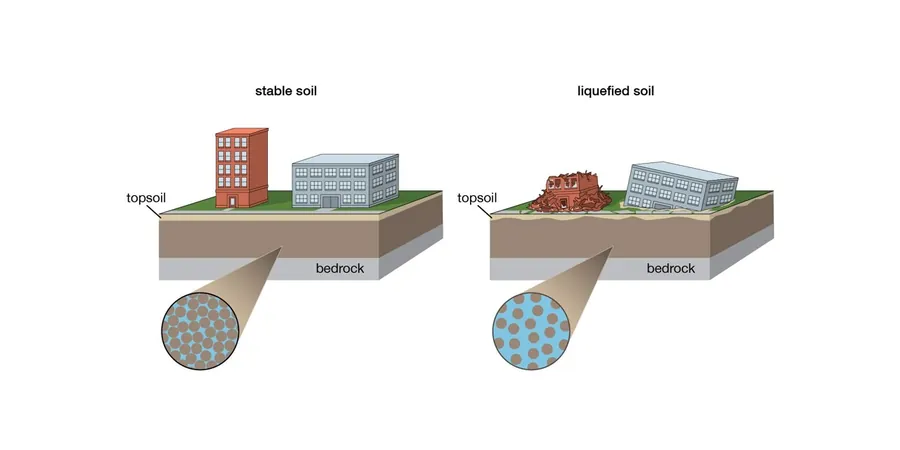
Liquefaction is a function of both shaking intensity and soil state; in Aurora’s Fox River deposits, the loose zone is often thinner than 6 feet but perfectly saturated—and that’s enough to cause differential settlement.
Technical details of the service in Aurora Illinois
Working video
Local geotechnical conditions in Aurora Illinois
The east side of Aurora, near the Fox Valley Mall area, sits on thicker outwash sand with groundwater at 6 feet below grade—prime conditions for cyclic mobility. Compare that to the west side, closer to the Precam-brian granite bedrock outcrops near Orchard Road, where the soil cover is thin silty clay over rock and liquefaction is not a design driver. That contrast within the same city limits means we cannot apply a single “Aurora default” assumption. For a warehouse slab-on-grade on the east side, ignoring liquefaction could lead to 3 to 4 inches of total settlement over a 50-year design life, cracking the slab and racking the storage system. The IBC requires a liquefaction study when the water table is within 50 feet of grade and the mapped spectral acceleration at 1-second period exceeds 0.10g—both true in Aurora’s floodplain areas. We deliver site-specific LPI (Liquefaction Potential Index) maps so the civil team can zone the site and isolate mitigation to the worst areas, keeping the construction budget under control.
Our services
Our liquefaction analysis in Aurora is built around three integrated methods that cover the full depth range from 0 to 100 feet, matching the typical glacial drift thickness in Kane County:
SPT-Based Liquefaction Assessment
We drill to 50 feet using hollow-stem augers with automatic SPT hammers, measure N-values every 2.5 feet, and run cyclic stress ratio (CSR) vs. cyclic resistance ratio (CRR) calculations per the NCEER workshop update. Thin-walled shelby tubes recover undisturbed samples for fines content and plasticity index in the same borehole.
CPT-Based Continuous Profiling
Seismic piezocone (SCPTu) pushes to 80 feet at 2 cm/sec, recording tip resistance, sleeve friction, and pore pressure. The continuous profile catches 2-inch-thick silt seams that control drainage during shaking—features SPT spacing misses. We output qc1Ncs and Ic soil behavior type every centimeter.
Shear Wave Velocity (Vs30) and Site Class
MASW array or downhole geophone measures Vs profiles for site class determination per ASCE 7-22 Table 20.3-1. We correlate Vs30 to liquefaction resistance for sites where invasive drilling is restricted, such as near active rail lines or the Fox River bank.
Common questions
At what depth does liquefaction risk stop in Aurora?
The risk drops sharply below 50 feet in Aurora because the glacial outwash sands transition to dense till or bedrock. We have logged Wisconsinan-age till with SPT N-values over 50 blows per foot at depths between 35 and 55 feet across Kane County. The IBC requires evaluation to the deepest liquefiable layer, but in practice, the CSR drops as overburden stress increases, and layers below 50 feet rarely produce a factor of safety below 1.5 for the design earthquake. We confirm with at least one deep SPT or CPT sounding per site.
How much does a liquefaction analysis cost for a commercial site in Aurora?
A complete liquefaction investigation for a typical 2-acre commercial site in Aurora ranges from US$2,340 to US$3,830, depending on the number of borings, depth, and whether we use SPT, CPT, or both. That covers field drilling, lab testing for fines content, the cyclic stress analysis, and the signed report with LPI maps. Sites requiring MASW or downhole Vs add about $900 to $1,400 per line. We provide a fixed-price proposal after reviewing the site plan and USGS hazard coordinates.
Does Aurora require a liquefaction study per building code?
Yes, the City of Aurora adopts the IBC with Illinois amendments, and IBC § 1804.5 triggers a liquefaction study when the design spectral acceleration at 1-second period (S1) exceeds 0.10g and the groundwater table is shallower than 50 feet. Aurora’s S1 is near 0.08g to 0.12g depending on site class, so most commercial and institutional projects on the east side of the Fox River must submit a liquefaction report with the foundation permit package.