Aurora sits on a complex glacial landscape where the upper 15 to 30 feet often consist of the Wedron Group tills—dense, silty clay with interspersed lenses of sand and gravel left by the Wisconsin Episode glaciation. When a project on the city's west side, near the Fox River, encounters these deposits, simple index tests rarely capture the true drained behavior of the material under load. We run the triaxial test because it isolates the effective stress parameters—cohesion and friction angle—that govern foundation bearing capacity and slope stability in these overconsolidated soils. A competent CPT test can map the stratigraphy continuously, but only the triaxial test measures the deviator stress at failure for a specific confining pressure, which is essential input for any finite element model of a deep excavation or mat foundation in Aurora's dense till.
A single CU triaxial test on Aurora's Wedron Till reveals a friction angle between 27 and 33 degrees—data that directly controls foundation width and reinforcement design.
Technical details of the service in Aurora Illinois
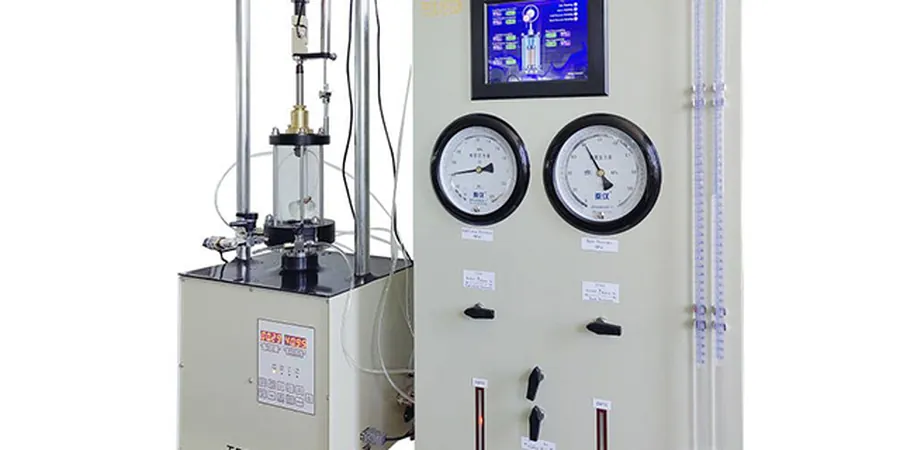
Local geotechnical conditions in Aurora Illinois
A mid-rise residential project on Aurora's far east side, near the Illinois Prairie Path, excavated 18 feet into stiff silty clay to accommodate underground parking. The original geotechnical report estimated undrained shear strength from pocket penetrometer readings on disturbed cuttings, resulting in a design that called for a cantilever soldier pile wall with minimal embedment. Within three weeks of excavation, inclinometers recorded 1.2 inches of lateral movement and a tension crack opened 8 feet behind the wall. We recovered Shelby tube samples from the excavation face and ran multi-stage CU triaxial tests that revealed an effective friction angle of 24 degrees—eight degrees lower than the preliminary assumption—along with a pronounced strain-softening response. The wall required a row of tieback anchors to restore the factor of safety above 1.5, a remediation that would have been unnecessary had the triaxial data been available during design.
Our services
We configure triaxial programs to match the specific loading scenarios and drainage conditions of your Aurora project. Every test package includes a detailed report with Mohr-Coulomb envelopes, stress-strain curves, and pore pressure response plots.
Consolidated-Undrained (CU) with Pore Pressure
Defines effective stress strength parameters (c' and φ') for saturated cohesive soils in Aurora. We run multi-stage tests on single specimens to reduce sample variability when recovery is limited.
Consolidated-Drained (CD) Testing
For free-draining granular layers encountered within Aurora's glacial outwash. The slow shearing rate (0.0005 in/min) allows full pore pressure dissipation, yielding the true drained friction angle for long-term stability analysis.
Unconsolidated-Undrained (UU) Quick Strength
Provides total stress parameters (Su) for short-term construction conditions. We select this protocol for preliminary embankment checks on the silty clays common beneath Aurora's industrial parks.
Common questions
What does a triaxial test cost for a project in Aurora?
A complete triaxial testing program—typically including three CU specimens from one Shelby tube sample—ranges from US$2,010 to US$2,890 depending on the required confining stress range and whether multi-stage techniques are applicable. That covers saturation, consolidation, shear, and a full engineering report with Mohr-Coulomb parameters and stress paths.
Which triaxial protocol is correct for the stiff clay till in Aurora?
Consolidated-Undrained with pore pressure measurement per ASTM D4767 is standard for Aurora's Wedron Group till. Because this overconsolidated clay dilates during shear, measuring pore pressure lets the lab separate the drained and undrained components of strength, which is critical for staged excavation analysis where partial drainage may occur.
How long does a triaxial test program take from sampling to report?
A CU test on low-permeability Aurora till typically requires 5 to 7 business days per specimen: 24 to 48 hours for backpressure saturation, another 24 hours for consolidation, and 8 to 12 hours for shearing at the ASTM-prescribed rate. A three-specimen program with reporting usually delivers in 15 working days; rush scheduling can compress this to 10 days.